Momo — Making Focus Feel Like a Game You Want to Win
A gamified focus timer with a hardcore mode that locks your distracting apps for the length of a session. Why I built it, what it does, and what changed along the way.
August 9, 2026 — 10 min read — momo · product · design · ios
I lost an afternoon to my phone a few months ago and couldn't tell you what to. Not a film, not a conversation, not anything I'd choose if you asked me directly. Just a scroll, then another one, then it was dark outside.
What bothered me wasn't the wasted time. It was that a focus timer had been running on that same phone the entire afternoon, quietly counting down while I ignored it, and then congratulating me at the end.
That's the flaw in almost every focus app I've tried. They ask you to concentrate and then politely watch while you don't. The timer has no idea whether you're working. It's a stopwatch with optimism attached.
So I built Momo — a focus timer that's actually a small game, with a mode that will genuinely take your distractions away from you.
The idea
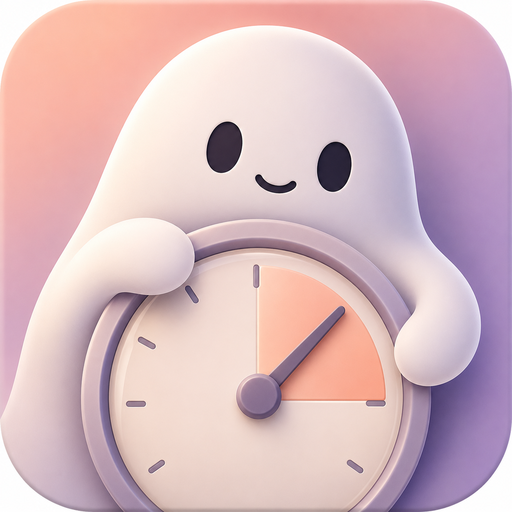
Momo has a character. A little pastel ghost that sits in the middle of the screen and reacts to what you're doing.



When you start a session it settles in and gets to work — a small determined wobble, the kind of face you make when you're concentrating. Finish the session and it celebrates, arms up, sparkles, the whole thing. Quit halfway and it droops. It goes visibly, unmistakably sad.
That sounds like a small detail. It is the entire product.
Nobody feels much about a progress bar resetting to zero. Everybody feels something about disappointing a small creature that was trying its best. Momo is built on that gap.
How a session works
You pick how long — one minute, five, fifteen, twenty-five, or no limit at all — and optionally name it. "Deep work." "Reading." "The thing I've been avoiding." A quiet reminder of what you actually sat down to do.
Then the screen clears to a full-screen 3, 2, 1. Nothing else on it. No character, no timer, no buttons. Three seconds of ceremony to mark the switch from about to work to working, because the moment you sit down is the moment the session is won or lost.
- Lock your phone freely. Putting it face-down is focusing, not cheating. The countdown carries on and shows up on your lock screen so you can glance without unlocking.
- Tap to pause. Someone walks in, the phone rings, life happens. Pausing costs you nothing and never counts against you. Paused time simply isn't focus time.
- Giving up is deliberately awkward. There's a quit control, but it's small, quiet and asks you to confirm. It shouldn't be the easiest thing on the screen.
Finish and you get a results screen — coins counting up with a bounce, XP filling your level bar, your ghost celebrating, and any achievements you just unlocked.
Easy and Hardcore
Before each session you choose a mode, and this is where Momo stops being polite.
Easy is a normal timer. Leave the app whenever you like and the session keeps running. It pays half the coins and XP.
Hardcore means what it says. Switch to another app and the session fails. Your ghost goes sad, and you earn nothing at all. Finish it and you take the full reward.
Nobody is forced into hardcore. But easy mode quietly costs you half of everything, and after a handful of sessions the choice starts making itself. It turned out to be far more persuasive than any amount of encouraging copy in the onboarding.
One thing hardcore will never do is punish you for locking your phone. Putting the phone down is the point — a dark screen is the most focused your phone can possibly be. The rule only cares about the real distraction, which is opening something else. And in any moment where it can't be completely certain what happened, it lets you off. Losing a session you'd honestly earned is a far worse experience than missing one you hadn't.
Hardcore mode's real teeth
Losing your rewards is a consequence, and consequences only work on people who were going to stop themselves anyway. For the rest of us — for me, on that lost afternoon — the distraction needs to not be there.
So Momo can lock your distracting apps outright.
You choose which ones once, in Apple's own picker: Instagram, TikTok, X, games, whole categories if you like. From then on, starting a session locks them. Try to open one mid-session and iOS shows a block screen instead. The session ends, they come back. That's the whole interaction.
It's a completely different feeling from a timer that scolds you. There's no negotiation, no moment where you talk yourself into "just checking something." The app you reached for simply isn't available, and after a couple of blocked taps your hand stops reaching. You picked this yourself, calmly, before you needed it — which is the only moment anyone makes that decision well.
There's a privacy detail I'm quietly proud of: Momo never learns which apps you chose. Apple hands back a sealed selection rather than a list, so the blocking works without the app ever knowing what it's blocking. Not a promise I'm asking you to trust — it genuinely cannot see them.
And if you pick the no-limit session — no timer, just work until you're done — the blocking switches on for the whole thing automatically. An open-ended session can't threaten to fail you, so it protects you a different way.
The game around the timer
Enforcement gets you through one afternoon. Nobody sticks with an app that only ever takes things away, so everything around the timer is built like a game.
Every finished session pays coins and XP. You level up. Coins are deliberately hard to come by — a couple per session, and characters cost hundreds — so the first ghost you unlock in the shop takes real weeks of actual focused work. It feels earned because it was.
There are 39 achievements, each with its own illustrated badge:






Your first session. Ten flawless ones. Fifty hours. A hundred-day streak. They unlock with a little celebration on the results screen, and they sit in a grid you can scroll back through when you want proof the last few months went somewhere.
Then there's everyone else:
- Focus rooms. Start a session with friends and you see their characters working alongside yours, live, for the whole session. It is astonishing how much harder it is to quit while someone's ghost is still going.
- Leaderboards and streaks. Friends or global, plus a daily streak that becomes weirdly precious around day nine.
- Stats worth looking at. A heatmap of when you actually focus. Most people are wrong about their own best hours, and it's oddly satisfying to find out you're a 10am person and not the night owl you'd been telling everyone about.
Planning it, then rebuilding half of it
I wrote Momo down before I built it. Every screen, every state, every edge case — what happens on a phone call, what happens if the app crashes mid-session, what the app should do when it isn't sure. It's the least glamorous part of building anything and it saves more time than any other habit I have.
And then reality corrected me anyway, always in the same direction: things I'd described as instant turned out to have a duration.
- Keeping the screen awake got cut entirely. My first plan was to stop the phone locking during a session. Exactly backwards. Let it lock, put the countdown on the lock screen instead — better for the battery, and much closer to how people actually focus.
- The celebration was too fast. Finishing used to jump straight to the results screen. Letting the ghost celebrate for a beat first is a change of about one second, and it's the single most satisfying moment in the app.
- Crashing used to be rewarded. Recovering an interrupted session originally gave you the full time back. Now it picks up from where you really were.
- The countdown started before you could see it. The "3" was appearing behind a closing panel, so it was half over by the time it was visible. Small thing, and it made the opening feel wrong in a way nobody would have been able to name.
None of those were in the plan. None of them could have been. They only show up when you're holding the actual phone, which is why I stopped trying to design that last ten percent in advance and started just using the thing every day.
Where it's going
Momo is close. The blocking works, the game around it works, the ghost is genuinely good company. The pieces still moving are the rest of the cast — more characters to unlock — and Apple's approval for the app-blocking feature, which is a form to fill in and then a wait.
What I keep coming back to is that the strictness and the softness aren't in tension. An app that only punishes you gets deleted within a week. An app that only encourages you gets ignored within two. The version that works is the one that takes the distractions off the table and gives you something small and round to be proud of at the end of it.
So that's Momo: twenty-five minutes, a locked phone, and a very small ghost that would really rather you didn't quit.